Khoom piav qhia:
Microfiber braided hlua
Nqe: Lub viav vias kos Valve tus nqi hloov pauv vim yog cov lus qhia tshwj xeeb, cov khoom siv thiab tus nqi pauv. Thov muab koj cov ntaub ntawv tiv tauj rau kuv, Kuv yuav hloov kho tus nqi tshiab tshaj rau koj

Lub check valve ua haujlwm li cas?
Cracking siab
A Swing Check Valve requires a minimum upstream pressure (pressure differential between inlet and outlet) to open the valve and allow flow through it. This minimum upstream pressure at which the valve opening occurs is called the check valve 'cracking pressure'. The specific cracking pressure changes based on the valve design and size, so ensure that your system can generate this cracking pressure and that it is suitable for the application.
Kaw
Yog hais tias lub siab ntws mus ib txhis poob qis dua lub siab tawg lossis muaj lub siab rov qab (khiav sim txav ntawm qhov hluav taws xob mus rau qhov nkag), ces lub valve yuav kaw. Nyob ntawm qhov kos valve tsim, lub kaw mechanism tuaj yeem hloov pauv. Nyob rau hauv luv luv, lub nraub qaum thawb lub rooj vag, pob, diaphragm, los yog disc tawm tsam lub qhov ncauj thiab kaw nws. Nyob ntawm tus qauv tsim cov txheej txheem kaw tuaj yeem pab tau los ntawm lub caij nplooj ntoos hlav lossis lub ntiajteb txawj nqus.
Installation Orientation
Raws li ib txoj kev valve tsuas ua haujlwm nyob rau hauv ib qho kev taw qhia, nws yog ib qho tseem ceeb kom paub qhov tseeb installation orientation. Feem ntau lub sij hawm, muaj ib tug xub nyob rau hauv lub valve vaj huam sib luag los qhia txog cov dej ntws. Txwv tsis pub, koj yuav tsum tau tshuaj xyuas lub valve kom ntseeg tau tias nws tau nruab rau hauv cov kev taw qhia ntws. Yog tias nws rov qab los, ntws yuav tsis tuaj yeem txav mus los ntawm lub kaw lus thiab kev tsim- nce siab tuaj yeem ua rau puas tsuaj.
Tshawb xyuas hom Valve
Nyob ntawm tus qauv tsim ntawm daim tshev valve, lawv yuav ua haujlwm txawv me ntsis. Feem ntau cov tshev valve yog lub caij nplooj ntoos hlav loaded hauv -line check valve, txawm li cas los xij, peb yuav tham txog ntau hom hauv qab no.
Caij nplooj ntoos hlav Loaded hauv -Kab
In-line spring loaded Swing Check Valve are common, easy to understand, and have a simple design. Figure 1 shows an example of a spring loaded in-line check valve and Figure 2 shows the main components with arrows showing flow direction. When flow enters the input port of the valve, it has to have enough pressure (force) to overcome the cracking pressure and the spring force. Once overcome, it pushes the disc, opening the orifice and allowing flow to move through the valve. When the input pressure is no longer high enough, or there is a backpressure, then the backpressure and spring push the disc against the orifice and seal the valve shut. The spring, along with the short travel distance for the disc, allows for quick reaction time for closing. This valve design also prevents against pressure surges in the line, and therefore, also prevents a water hammer from occurring. Common types of spring loaded in-line check valves are also called 'nozzle check valves' or 'silent check valves.' They can be installed in a vertical or horizontal orientation. However, since they are in-line to the system, they have to be fully removed from the line to be inspected and/or perform maintenance.

Caij nplooj ntoos hlav Loaded Y
Spring loaded y-check valves operate very similar to in-line spring loaded check valves. The difference, as you can see in Figure 3, is that the spring and movable disc are positioned at an angle. This creates a 'y' shape, hence the name of the valve. It works the exact same as an in-line valve, but since the moveable components are at an angle it can be inspected and serviced while it is still connected to the system. However, they are larger and take up more room within the system.

Pob
A ball check valve uses a free-floating or spring-loaded ball that rests on the sealing seat to close the orifice. The sealing seat is normally conically tapered in order to guide the ball into the seat and create a positive seal, thereby, stopping reverse flow. When the pressure of the fluid in the inlet side exceeds the cracking pressure, the ball is dislodged from its seat and allows flow to occur. When the inlet pressure doesn't exceed the cracking pressure, or there is back pressure, the ball will close with the back pressure or via the spring, effectively closing the orifice.

Daim duab 4: Lub caij nplooj ntoos hlav loaded pob kos valve nrog lub inlet chaw nres nkoj ntawm sab laug thiab qhov hluav taws xob qhov hluav taws xob ntawm sab xis.
Diaphragm
Diaphragm check valves consist of a rubber diaphragm that flexes open when the inlet pressure is increased. Normally, these types of valves have a free-floating self-centering diaphragm, which makes them normally open (NO). These means that there is no "cracking pressure", however, they can be normally closed (NC) and then it requires an inlet pressure to overcome the diaphragms elasticity. Figure 5 on the left shows a normally open diaphragm check valve as there is 'minimal' inlet pressure and the media still gets through. As inlet pressure increases, the diaphragm will flex open more allowing flow through, as seen in Figure 5 in the middle. If backpressure occurs (or it is a normally closed diaphragm check valve) the diaphragm will be forced against the opening and seal it to prevent any backflow, as seen in Figure 5 on the right. Due to the normally open nature, diaphragm check valves are ideal for low-pressure or vacuum applications.

Nqa
Lub lift check valve muaj ib qho kev taw qhia disc uas tsa (lifts) tawm ntawm lub rooj zaum valve kom tso cai rau cov xov xwm ntws. Nws yuav tsum muaj lub siab tawg kom kov yeej lub ntiajteb txawj nqus thiab/los yog lub caij nplooj ntoos hlav thiab cov lus qhia khaws cov disc nyob rau hauv ib txoj kab ntsug, kom lub disc tuaj yeem rov qab tau - zaum nrog qhov raug thiab sib khi. Feem ntau, nqa cov tshev valve xav tau cov xov xwm los ua 90-degree tig, raws li pom hauv daim duab 6, tab sis muaj cov check li qub uas nyob hauv kab lossis ntawm lub kaum sab xis. Raws li lub siab nkag hauv qab qis dua lub siab tawg lossis muaj lub nraub qaum, lub valve yuav kaw los ntawm lub ntiajteb txawj nqus, lub caij nplooj ntoos hlav, thiab / lossis los ntawm kev siv lub backpressure. Yog tias tsis muaj lub caij nplooj ntoos hlav los pab kaw, mounting orientation hais txog lub ntiajteb txawj nqus yog ib qho tseem ceeb los xyuas kom meej tias lub disc yuav viav vias kaw nrog lub ntiajteb txawj nqus.

Swing
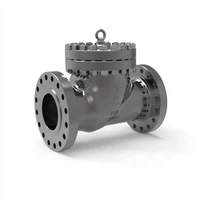
Swing check valves are also commonly referred to as 'tilting-disc' check valves. They consist of a disc that is on a hinge (or trunnion) that swings open with an inlet pressure. As inlet pressure decreases or there is a backflow, the disc will swing shut. If there is no spring to assist in closing, mounting orientation in regard to gravity is important to ensure that the disc will swing shut with gravity. Figure 7 shows an example of a swing check valve.

Nres
Ib qho chaw nres tsheb valve feem ntau yog lub caij nplooj ntoos hlav loaded y-check valve los yog lub lift check valve, tab sis nws muaj ib tug phau ntawv override feature. Qhov no tso cai rau lawv ua haujlwm raws li ib txwm kos valve thiab tiv thaiv kev rov qab, txawm li cas los xij, muaj cov txheej txheem sab nraud uas tuaj yeem siv los hla nws thiab tswj lub valve hauv lub xeev qhib lossis kaw. Yog li, lub valve no tuaj yeem ua haujlwm raws li ob lub valve hauv ib qho. Lawv feem ntau siv nyob rau hauv cov chaw tsim hluav taws xob, boiler ncig, chav generators, turbine txias, kev ruaj ntseg systems.

Npauj npaim los yog Wafer
Npauj Npaim kos li qub thiab lub wafer kos li qub tuaj yeem siv sib hloov. Lawv muaj ib tug npauj npaim, los yog wafer, style disc uas nyob rau ntawm lub pob khawm thiab lub caij nplooj ntoos hlav. Thaum inlet siab overcomes lub cracking siab, ob sab qhib, raws li pom nyob rau hauv daim duab 9. Thaum lub inlet siab txo los yog muaj ib tug backflow, lub caij nplooj ntoos hlav ntawm lub pob khawm (los yog backpressure) yuav kaw lub disc zoo sealing nws. Hom valve no tso cai rau cov xov xwm ncaj nraim nrog kev cuam tshuam tsawg.

Xyuas Valves rau Dej
Kos li qub yog siv rau hauv ntau daim ntawv thov dej, xws li cov dej haus thiab cov dej khib nyiab, thiab tsuas yog hu ua ib txoj hauv dej li qub. Rau cov ntawv thov dej haus, lawv xyuas kom meej tias tsis muaj kev tshaj tawm los ntawm ib puag ncig (qhov hluav taws xob sab ntawm lub valve) tuaj yeem nkag mus rau hauv lub cev nrog cov dej huv huv uas muaj kev nyab xeeb thiab tsis muaj paug. Rau cov ntawv thov dej khib nyiab, lawv xyuas kom meej tias cov dej khib nyiab tsis tuaj yeem rov- nkag mus rau hauv lub cev thiab ua rau muaj kev sib kis ntxiv los yog muaj kab mob ntxiv. Rau cov ntawv thov siv dej, feem ntau siv lub ko taw valve los xyuas kom meej tias tsis muaj cov khib nyiab nkag mus rau hauv kab thiab ua kom lub siab sab hauv rau lub hom phiaj priming. Duckbill li qub kuj tseem siv tau rau kev tso tawm ntawm cov kab dej. Lub tshuab nqus tsev twj tso kua mis xyuas kom ntseeg tau tias cov dej tso tawm tsis rov qab los rau hauv lub twj tso kua mis nrog lub ntiajteb txawj nqus thaum lub twj tso kua mis raug kaw.
Pneumatic Check Valve
Lub pneumatic check valve, los yog huab cua check valve, tso cai rau cov cua ntws mus rau hauv thiab tiv thaiv kom tsis txhob tawm mus. Lawv feem ntau tsuas yog hu ua ib txoj kev cua li qub. Daim ntawv thov feem ntau yog rau lub tshuab cua compressor. Lawv tso cai rau lub compressor khaws qee qhov chaw siab thiab lwm qhov chaw de-pressurized. Lawv tuaj yeem nyob ntawm lub piston compressor (qhov nkag thiab qhov hluav taws xob), cua txais, tso tawm cov yeeb nkab, thiab lwm yam.
Cov lus nug nquag
Lub cim kos valve yog dab tsi?
The check valve symbol can be seen in Figure 13. It points in the orientation that it allows the flow with a vertical line showing it doesn't allow backflow.

Daim duab 13: Kos lub cim valve
Lub hom phiaj ntawm daim tshev valve yog dab tsi?
Lub hom phiaj tseem ceeb ntawm kev kos valve hauv ib qho system yog los tiv thaiv kev rov qab los, uas tuaj yeem ua rau cov khoom puas tsuaj los yog kis kab mob tawm mus.
Dab tsi yog cov teeb meem kuaj valve?
Common check valve problems are: noise, water hammer, vibration, reverse flow, sticking, leakage, and component wear/damage. To prevent issues, it is crucial that a check valve is specified correctly for the application and media. The two most common issues due to improper specification are reverse flow and water hammer. For both issues, a fast-closing check valve should be used. Reverse flow can occur if the check valve doesn't close fast enough and water hammer can occur if pressure surges occur causing shock waves within the media.
Lub check valve puas yuav nres dej rauj?
Lub pob valve tuaj yeem tiv thaiv dej rauj yog tias nws ua haujlwm nrawm. Qhov no tiv thaiv kev ntxhov siab, uas ua rau muaj kev poob siab thoob plaws hauv xov xwm. Cov kev poob siab no tuaj yeem ua rau cov khoom puas tsuaj, cov yeeb nkab txhawb nqa, thiab txawm tias cov kav dej tawg vim qhov kev co.
Dab tsi yog qhov kev taw qhia yuav tsum tau nruab ib daim tshev valve?
Kos li qub yuav tsum tau muab tso rau hauv raws li lawv cov inlet thiab qhov hluav taws xob, uas yog feem ntau qhia raws li ib tug xub ntawm lub valve vaj tse. Raws li lawv tsuas tso cai ntws mus rau hauv ib qho kev taw qhia, yog tias lawv tau nruab rov qab, lawv yuav tsis ua haujlwm zoo. Nyob rau hauv cov nqe lus ntawm kab rov tav los yog ntsug, nws nyob ntawm koj lub valve tsim hom. Yog hais tias nws muaj lub caij nplooj ntoos hlav, ib qho kev taw qhia zoo. Yog tias tsis muaj lub caij nplooj ntoos hlav, lub ntiajteb txawj nqus tuaj yeem cuam tshuam rau kev ua haujlwm ntawm lub valve, yog li xyuas kom koj paub cov khoom siv sab hauv yuav xyuas kom koj nruab nws kom raug nyob rau hauv kab rov tav lossis ntsug.
Vim li cas kuv lub valve tsis ua haujlwm?
When a check valve doesn't work, it allows backflow. Three possible reasons for this are: sticking, leakage, or slow closing. If there isn't a filter in the line, dirt or debris can be trapped between the disc and body keeping it open. Due to wear or corroding media on the material, the disc or seat can become damaged or torn preventing a proper seal and allowing backflow. If the valve closes too slow, minimal backflow can enter before a proper seal can occur. Ensure that gravity is helping the design, and/or your spring is quick enough to close the valve rapidly.
Cim npe nrov: zog kos valve